Quick start
Since the library is built on the Keras framework, created segmentation model is just a Keras Model, which can be created as easy as:
from segmodels_keras import Unet

model = Unet()
Depending on the task, you can change the network architecture by choosing backbones with fewer or more parameters and use pretrainded weights to initialize it:
model = Unet('resnet50', encoder_weights='imagenet')
Change number of output classes in the model:
model = Unet('resnet50', classes=3, activation='softmax')
Change input shape of the model:
model = Unet('resnet50', input_shape=(None, None, 6), encoder_weights=None)
Simple training pipeline
from segmodels_keras import Unet
from segmodels_keras import get_preprocessing
from segmodels_keras.losses import bce_jaccard_loss
from segmodels_keras.metrics import iou_score

BACKBONE = 'resnet50'
preprocess_input = get_preprocessing(BACKBONE)

# load your data
x_train, y_train, x_val, y_val = load_data(...)

# preprocess input
x_train = preprocess_input(x_train)
x_val = preprocess_input(x_val)

# define model
model = Unet(BACKBONE, encoder_weights='imagenet')
model.compile('Adam', loss=bce_jaccard_loss, metrics=[iou_score])

# fit model
model.fit(
    x=x_train,
    y=y_train,
    batch_size=16,
    epochs=100,
    validation_data=(x_val, y_val),
)
Models and Backbones
Models
Unet |
Linknet |
|---|---|
|
|
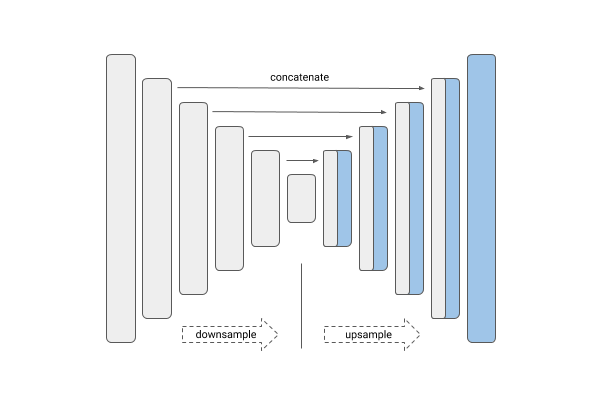
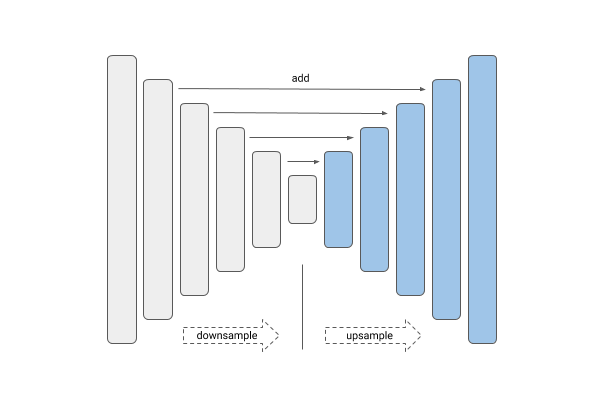
PSPNet |
FPN |
|---|---|
|
|
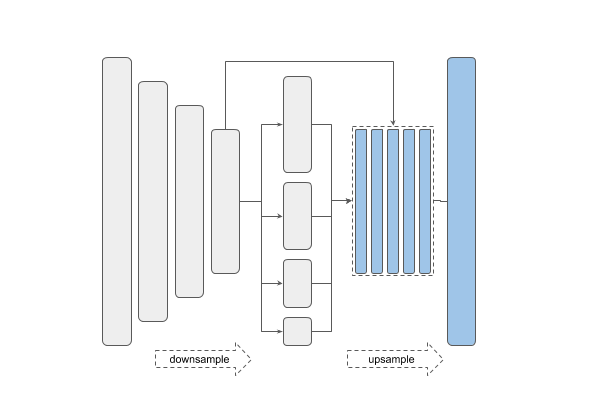
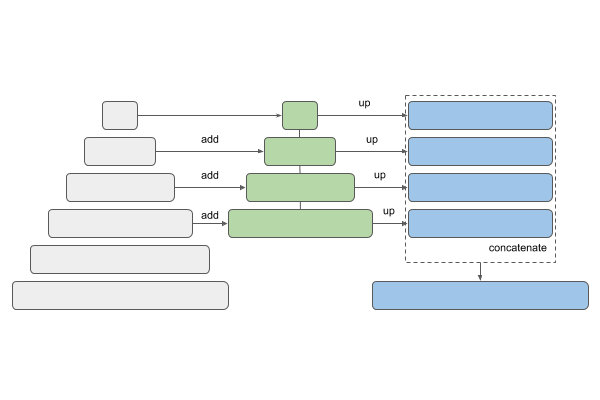
Backbones
Type |
Names |
|---|---|
VGG |
|
ResNet |
|
ResNetV2 |
|
DenseNet |
|
Inception |
|
MobileNet |
|
EfficientNet |
|
EfficientNetV2 |
|
All backbones have weights trained on 2012 ILSVRC ImageNet dataset (
encoder_weights='imagenet').
Fine tuning
Some times, it is useful to train only randomly initialized
decoder in order not to damage weights of properly trained
encoder with huge gradients during first steps of training.
In this case, all you need is just pass encoder_freeze = True argument
while initializing the model.
from segmodels_keras import Unet
from segmodels_keras.utils import set_trainable

model = Unet(backbone_name='resnet50', encoder_weights='imagenet', encoder_freeze=True)
model.compile('Adam', 'binary_crossentropy', ['binary_accuracy'])

# pretrain model decoder
model.fit(x, y, epochs=2)

# release all layers for training
set_trainable(model) # set all layers trainable and recompile model

# continue training
model.fit(x, y, epochs=100)
Training with non-RGB data
In case you have non RGB images (e.g. grayscale or some medical/remote sensing data) you have few different options:
Train network from scratch with randomly initialized weights
from segmodels_keras import Unet

# read/scale/preprocess data
x, y = ...

# define number of channels
N = x.shape[-1]

# define model
model = Unet(backbone_name='resnet50', encoder_weights=None, input_shape=(None, None, N))

# continue with usual steps: compile, fit, etc..
Add extra convolution layer to map
N -> 3channels data and train with pretrained weights
from segmodels_keras import Unet
from keras.layers import Input, Conv2D
from keras.models import Model

# read/scale/preprocess data
x, y = ...

# define number of channels
N = x.shape[-1]

base_model = Unet(backbone_name='resnet50', encoder_weights='imagenet')

inp = Input(shape=(None, None, N))
l1 = Conv2D(3, (1, 1))(inp) # map N channels data to 3 channels
out = base_model(l1)

model = Model(inp, out, name=base_model.name)

# continue with usual steps: compile, fit, etc..